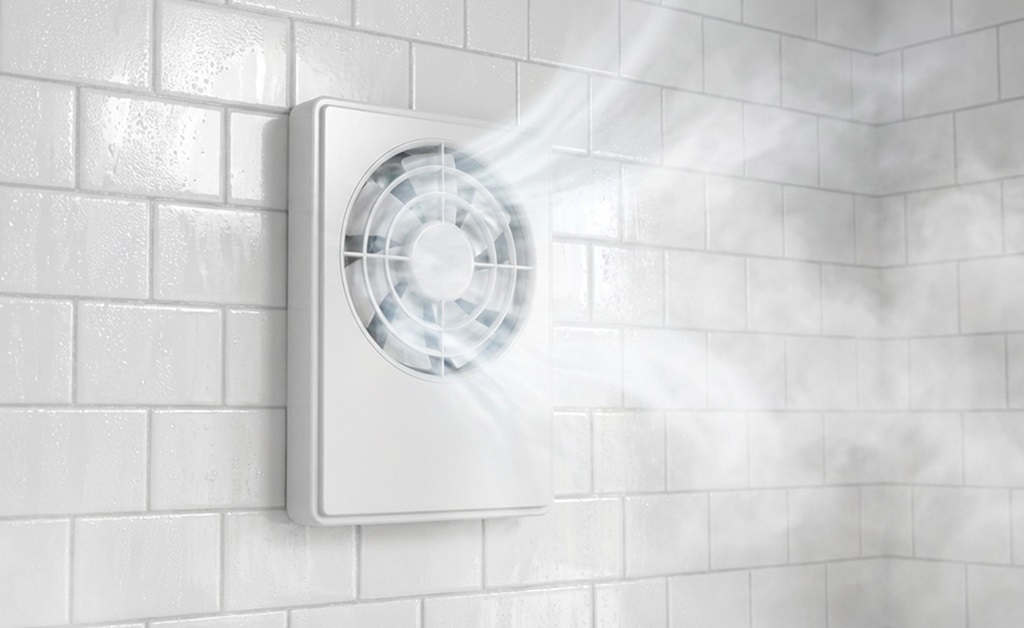
Ventilation should remove moisture and pollutant-laden air, introduce fresh air and help maintain healthy indoor conditions. But simply having fans or vents installed does not mean the strategy is working.
Simon Trenerry, technical advisor at Safeguard Europe shares five warning signs your ventilation might not be working as well as it could.
1. Condensation keeps returning
Condensation forms when humid air meets a sufficiently cold surface. Persistent condensation is one of the clearest indicators that moisture is not being removed effectively. Windows often show it first during colder months, but condensation can also form on external walls, window reveals, ceilings and other cold surfaces. Surface temperature matters too, so thermal bridging or insulation defects may contribute.
Occasional condensation does not necessarily indicate a serious problem. However, windows that are regularly wet in the morning, damp window sills or recurring moisture in bathrooms and kitchens suggest that indoor humidity may be staying too high for too long.
Rather than treating the visible water as the problem, it’s a good idea to investigate whether extraction rates, background ventilation and airflow through the property are adequate.
2. Mould returns after treatment
Cleaning or treating mould addresses the immediate contamination, but it does not necessarily remove the conditions that allowed it to develop.
If black mould repeatedly returns in the same areas after treatment, there may still be an underlying moisture problem.
Look closely at the pattern. Mould around windows, in corners, behind furniture and on external walls can be associated with condensation, particularly where surfaces are colder or air movement is restricted.
Recurring mould should therefore prompt a wider assessment. Ventilation, heating, insulation, leaks and other potential sources of damp all need to be considered rather than assuming that one measure will solve every case.
3. Extractor fans are installed – but aren’t effective
The presence of an extractor fan is not the same as effective extraction.
Fans may be incorrectly specified, poorly maintained, obstructed or simply no longer performing as intended. Ducting can also affect performance.
Resident behaviour matters too. If a fan is noisy or occupants believe it is expensive to run, they may switch it off. This is particularly important with continuous-running systems, which rely on consistent operation.
For housing providers, inspections should go beyond checking whether a fan exists. Is it operating? Is it extracting effectively? Is it appropriate for the room? And does the resident understand how it is designed to work?
4. The property has become more airtight
Energy-efficiency improvements can significantly change how moisture behaves inside a property. Replacement windows, draught-proofing and insulation can all reduce uncontrolled air leakage. That is beneficial for energy efficiency, but without an appropriate ventilation strategy it can also leave moisture with fewer routes to escape.
This is why ventilation should be assessed alongside retrofit rather than as an afterthought. Building work should not leave the dwelling’s ventilation provision worse than before.
Where condensation or mould complaints begin following energy-efficiency works, housing providers should consider whether the building’s ventilation provision remains suitable for its new level of airtightness.
5. You’re solving individual rooms, not the whole property
A powerful extractor fan in a bathroom cannot compensate for poor airflow throughout the rest of a home.
Effective moisture management requires a joined-up approach. High moisture areas such as kitchens, bathrooms and utility rooms need suitable extraction, while bedrooms and living areas need adequate background ventilation and pathways that allow air to move through the property.
For homes experiencing persistent or widespread condensation, a whole-house approach such as Positive Input Ventilation (PIV), combined with appropriate extraction and passive ventilation where required, may provide a more suitable solution.
Take a whole-property approach
Recurring condensation, mould and musty air should not simply become part of the repairs cycle. They are signals that something within the building’s moisture management strategy may need further investigation.
The priority should be to diagnose the cause before specifying the solution. Assess ventilation performance alongside heating, insulation, building condition and resident needs, then select measures appropriate to the individual property.
Safeguard Europe provides technical guidance, training and the Dryzone range of ventilation solutions for tackling condensation, damp and mould.
Safeguard Europe – Leading UK Manufacturer in Building Protection